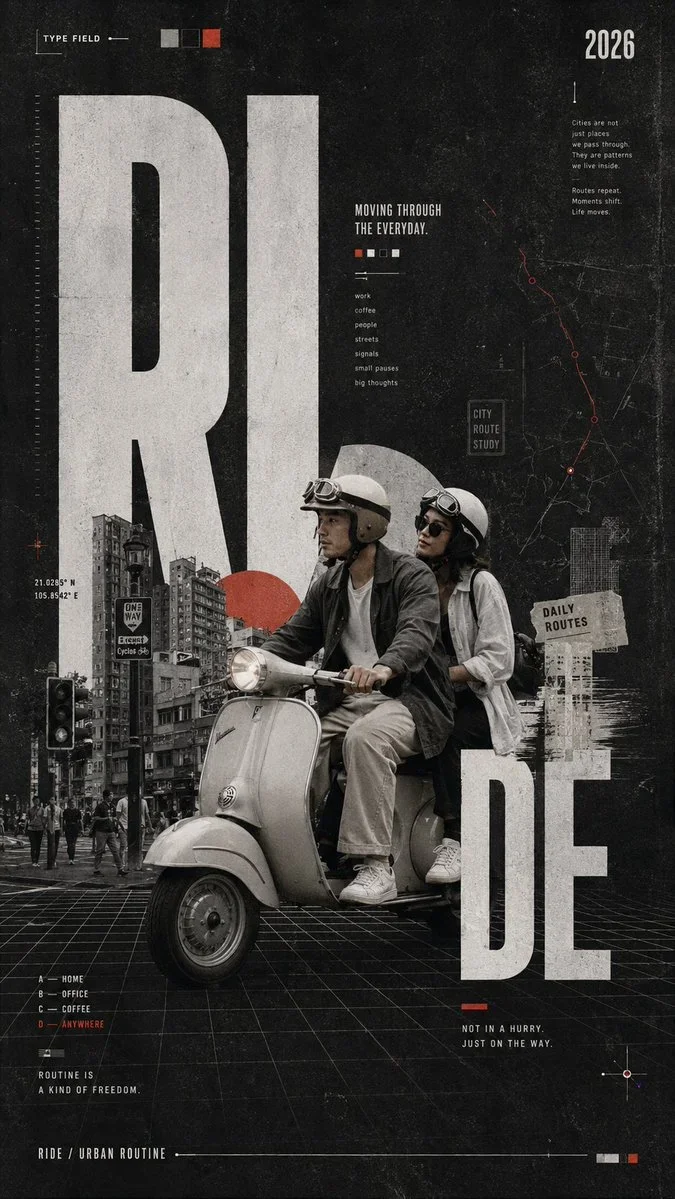
The prompt

The prompt defines the subject, layout, negative space, and graphic treatment so the result can support a clear poster composition. Its strongest visual cues are editorial, minimal, poster.

image prompt
{{sport}}: {{trailRunningSwimmingSkateboardingCycling}} {{action}}: {{specificAthleticMovement}} {{force}}: {{terrainWaterResistanceImpulseAirflow}} [Scene]: {{environment}} {{accentColor}}: the intended color the intended title: the intended title the intended keywords: the intended 3 short words the intended format: 9:16 vertical Create an experimental sports editorial poster that visualizes the invisible forces created by movement. Use a deep black background with large negative space, realistic action photography, organic photo cropping, minimal typography, and one continuous flowing-line system. Capture the athlete in a natural, believable moment of motion. Keep realistic anatomy, equipment, materials, skin texture and healthy natural skin tone. The athlete should not look at the camera. Let the graphic lines originate naturally from the action or environment: ACTION → FORCE → FLOW For example, terrain shapes the lines around a runner, water currents follow a swimmer, impulse rises from a skateboard takeoff, or airflow bends around a cyclist. Use 30–60 long, thin, smooth continuous curves. Keep them elegant, evenly spaced and gradually changing in curvature. Let the lines compress, stretch and release according to the force of the movement. Keep all lines continuous and clean — no broken segments, random intersections, short fragments, nodes, particles, polygon networks or technical UI graphics. Flow lines should follow around the athlete’s silhouette rather than crossing exposed skin or obscuring the body. Use a restrained palette: black, neutral photographic tones, white/gray lines, plus one subtle accent color. The final image should feel like premium sports culture × generative graphic design, where the lines reveal the beauty, force and rhythm of athletic motion rather than simply decorating the photograph.

Tune the prompt, not the plumbing.

Every control comes from this prompt’s content schema. Changes stay in your browser and update instantly.

Customized prompt1938 characters
the intended sport: the intended trail running swimming skateboarding cycling the intended action: the intended specific athletic movement the intended force: the intended terrain water resistance impulse airflow [Scene]: specific environment the intended accent color: the intended color the intended title: the intended title the intended keywords: the intended 3 short words the intended format: 9:16 vertical Create an experimental sports editorial poster that visualizes the invisible forces created by movement. Use a deep black background with large negative space, realistic action photography, organic photo cropping, minimal typography, and one continuous flowing-line system. Capture the athlete in a natural, believable moment of motion. Keep realistic anatomy, equipment, materials, skin texture and healthy natural skin tone. The athlete should not look at the camera. Let the graphic lines originate naturally from the action or environment: ACTION → FORCE → FLOW For example, terrain shapes the lines around a runner, water currents follow a swimmer, impulse rises from a skateboard takeoff, or airflow bends around a cyclist. Use 30–60 long, thin, smooth continuous curves. Keep them elegant, evenly spaced and gradually changing in curvature. Let the lines compress, stretch and release according to the force of the movement. Keep all lines continuous and clean — no broken segments, random intersections, short fragments, nodes, particles, polygon networks or technical UI graphics. Flow lines should follow around the athlete’s silhouette rather than crossing exposed skin or obscuring the body. Use a restrained palette: black, neutral photographic tones, white/gray lines, plus one subtle accent color. The final image should feel like premium sports culture × generative graphic design, where the lines reveal the beauty, force and rhythm of athletic motion rather than simply decorating the photograph.

Useful structure, room to move.

The prompt defines the subject, layout, negative space, and graphic treatment so the result can support a clear poster composition. Its strongest visual cues are editorial, minimal, poster.

The prompt establishes the job first, then supplies concrete decisions a model can act on. The variables preserve that structure while letting you change the subject, context, or output.

Editorial Minimal Design — image prompt preview